
🏷️ Science · 📅 Updated November 8, 2026 · ✍️ By Riley Fox · ⏱ 10 min read

She never asked to be a hero. She was just a gentle stray who trusted the humans who found her.
Laika was a stray dog from the streets of Moscow who, on November 3, 1957, became the first living creature launched into Earth orbit, aboard the Soviet spacecraft Sputnik 2 (Britannica). There was no way to bring her back. For decades the Soviet Union claimed she survived for days in orbit, but data revealed in 2002 showed she died of overheating and stress just five to seven hours after launch.
Sixty-nine years later, she is still one of the most quietly heartbreaking figures in the history of space exploration. This isn't a list article. It's her story, including the parts the world wasn't told for nearly half a century. At the end, you'll find pet names inspired by Laika and the space program that carried her.
🐾 Who was Laika?
Before she was Laika, she was one of thousands of stray dogs living on the streets of Moscow. Soviet scientists deliberately recruited female strays: they were smaller, seemed calmer, and, having already survived hunger and cold, were expected to cope with the extremes of spaceflight (Smithsonian). Females also had a practical advantage in the cramped capsule, because they didn't need to lift a leg (RFE/RL).
Laika weighed about 6 kilograms (13 pounds) and was a small mixed-breed dog (Britannica), often described as a husky or spitz mix, about three years old (Smithsonian). Her handlers first called her Kudryavka, "Little Curly." The public came to know her as Laika, a Russian word meaning "barker." One trainer described her as "quiet and charming" (RFE/RL).
Her keeper, Vladimir Yazdovsky, took her home to play with his children shortly before the flight. He later explained that he "wanted to do something nice for the dog" (Smithsonian).
Training was hard. Candidate dogs lived in progressively smaller pressurized capsules for days, then weeks, and were tested for their reactions to pressure changes and loud noises. Some dogs even held in their waste rather than use the capsule's sanitation device (Smithsonian). Dogs also trained in centrifuges to simulate the forces of launch (RFE/RL).
🚀 The Sputnik 2 mission: a one-way ticket
Just a month earlier, the Soviet Union had stunned the world with Sputnik 1, the first artificial satellite. Premier Nikita Khrushchev wanted a follow-up in time for the anniversary of the 1917 Bolshevik Revolution, and engineers had about four weeks to build it (RFE/RL). There was no time to design a way to bring a passenger home.
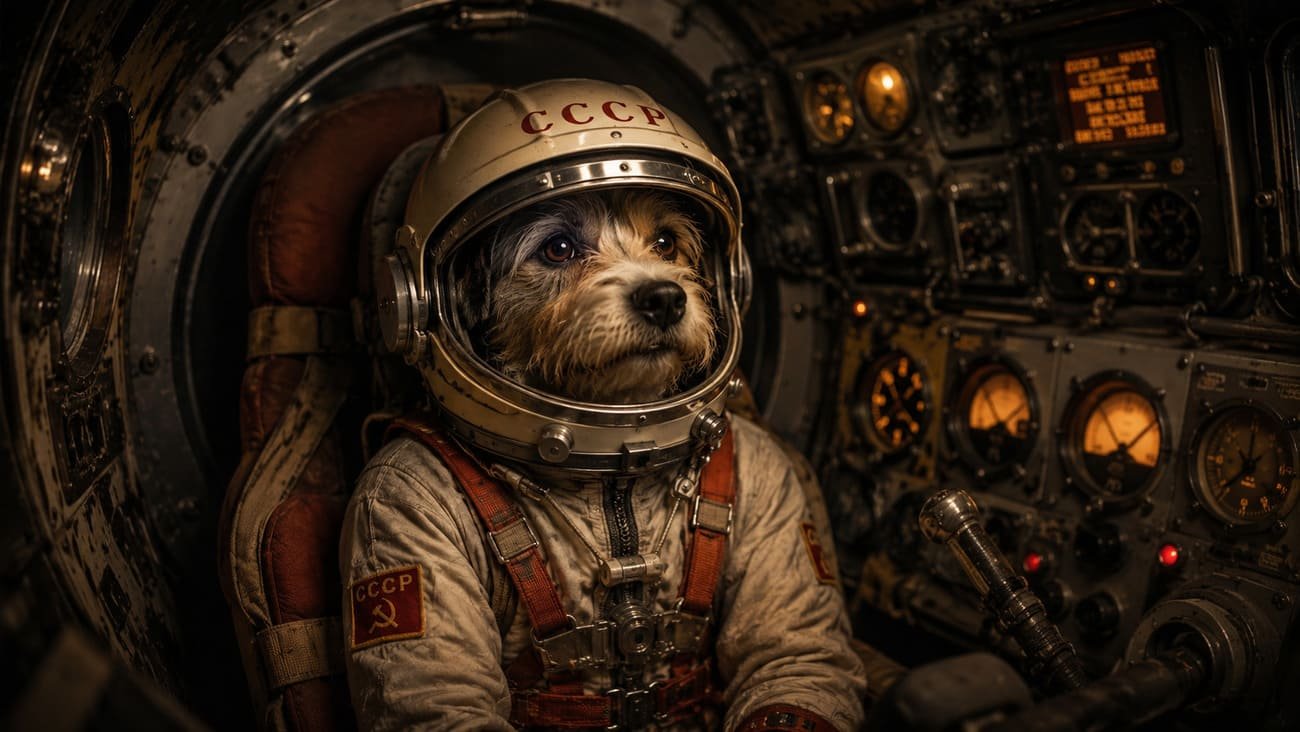
Laika was placed in her small capsule days before the launch, wearing a harness that let her stand, sit, and lie down but not turn around. When Sputnik 2 lifted off at 5:30 a.m. on November 3, 1957, the G-forces reached five times normal gravity. Telemetry showed her heartbeat rising to triple its normal rate and her breathing to four times its normal rate (Smithsonian).
She made it to orbit. For the first time ever, a living creature was circling the planet. But everyone involved knew, before she ever left the ground, that Sputnik 2 had no way to return.
💔 The truth about Laika's final hours
For decades, the world was told a gentler story. Soviet accounts implied that Laika lived in orbit for six or seven days before being painlessly put to sleep (Britannica). Newspapers around the world mourned her as a peaceful space heroine.
The real story was crueler. In 2002, Russian scientist Dimitri Malashenkov revealed that Laika had actually died about five to seven hours after liftoff, from overheating and panic (Britannica). A cooling system had failed, and she died after circling the Earth four times (RFE/RL).
Oleg Gazenko, one of the scientists who worked on the program, later expressed his regret: "The more time passes, the more I'm sorry about it" (Smithsonian).
Her capsule kept circling the Earth for about five more months, until Sputnik 2 was destroyed on re-entry into the atmosphere on April 14, 1958 (Britannica).
🐕 Not alone: the other dogs of the Soviet space program
Laika is the name history remembers, but she was part of a much larger program that flew many stray dogs in the 1950s and 1960s.
Dezik & Tsygan
July 22, 1951
Flew to about 110 km aboard an R-1 rocket and were recovered unharmed, among the first dogs to survive a spaceflight (Universe Today).
Albina
Laika's backup
Her name means "White." She was the backup dog for the Sputnik 2 mission and was spared the fatal flight (Smithsonian).
Belka & Strelka
August 19, 1960
Flew aboard Sputnik 5 with 40 mice, 2 rats, and plants, and returned safely after a day in orbit (NASA). Their success paved the way for Yuri Gagarin's flight in 1961.

🧠 Laika's legacy
Laika's flight sparked one of the first global debates about animals in scientific research. In Britain, the RSPCA and other animal welfare groups protested, and dog lovers marched outside the United Nations in New York (Smithsonian). That debate still shapes how space agencies think about animal research today.
In April 2008, Russian officials unveiled a small monument near the Moscow military research facility that had prepared her flight: a dog standing on top of a rocket (The Spokesman-Review / AP). She's remembered today not as a piece of Cold War propaganda, but as the small, brave dog whose flight helped make human spaceflight possible.
✨ Pet names inspired by Laika and the space race
If Laika's story moved you, here are names with real history behind them, for a pet who deserves a little piece of her legacy.
The Pushinka connection: Strelka later had a litter of six puppies. One of them, Pushinka, was given to President John F. Kennedy's daughter, Caroline (Smithsonian). For more star-inspired ideas, see our celestial pet names and zodiac pet names.
🌌 Why Laika's story still matters
It would be easy to file Laika away as a piece of Cold War trivia. But her story keeps resurfacing, in documentaries, graphic novels, songs, and bands named after her, because it touches something that has nothing to do with rockets: the quiet, complicated love between humans and the animals who trust us completely.
Every dog who has waited by a door, ridden along in a car without asking where it's headed, or followed a beloved human into an unfamiliar room has a little of Laika in them. She didn't know what orbit meant, or that she would never come home. She went because the people around her asked her to. If you've adopted a stray of your own, our rescue pet naming guide has more names with meaning.
❓ Frequently asked questions
Was Laika the first animal in space?
No. Fruit flies and several dogs had already flown on shorter suborbital trips, including Dezik and Tsygan in 1951. Laika was the first living creature launched into Earth orbit, on November 3, 1957.
How did Laika die?
In 2002, Russian scientist Dimitri Malashenkov revealed that Laika died about five to seven hours after launch from overheating and panic, after a cooling system failed. Soviet accounts had claimed she lived for several days.
Is Laika still in space?
No. Sputnik 2 kept orbiting for about five months after her death and was destroyed on re-entry into the atmosphere on April 14, 1958.
What breed was Laika?
Laika was a small mixed-breed stray of about 6 kg (13 lb), often described as a husky or spitz mix. She was found on the streets of Moscow.
Which dogs were the first to orbit Earth and return alive?
Belka and Strelka. They flew aboard Sputnik 5 on August 19, 1960, with 40 mice, 2 rats, and plants, and returned safely the next day.
Sources
- Britannica: Laika (Soviet space dog)
- Smithsonian Magazine: The sad story of Laika, the space dog
- RFE/RL: Laika, the Soviet dog in space
- Universe Today: Space dogs
- NASA StarChild: First animals to return from space
- Smithsonian Air & Space: Belka and Strelka, Soviet space celebrities
- The Spokesman-Review (AP): Monument honors Laika (2008)
Give your pet a name with real courage behind it
Try the Famous theme with the Brave or Adventurous trait.
Start the Generator
Riley Fox is the pen name of the independent web developer who built and runs Pet Name Generator from Campo Grande, Brazil, a tree-lined city at the edge of the Pantanal. Riley shares home with three cats, Mindinha (a tuxedo), Kuku (a Siamese) and Lelinho (an orange tabby), plus Mille, a very sociable Shih Tzu. Riley writes every naming guide and pet-care tip on the site, researching each one with veterinary and animal-welfare sources. Not a vet, just a dedicated pet parent. More on the About page.