🏷️ Guides · 📅 Updated November 8, 2026 · ✍️ By Riley Fox · ⏱ 11 min read
The first week sets the tone for the next fifteen years. A little preparation goes a long way.
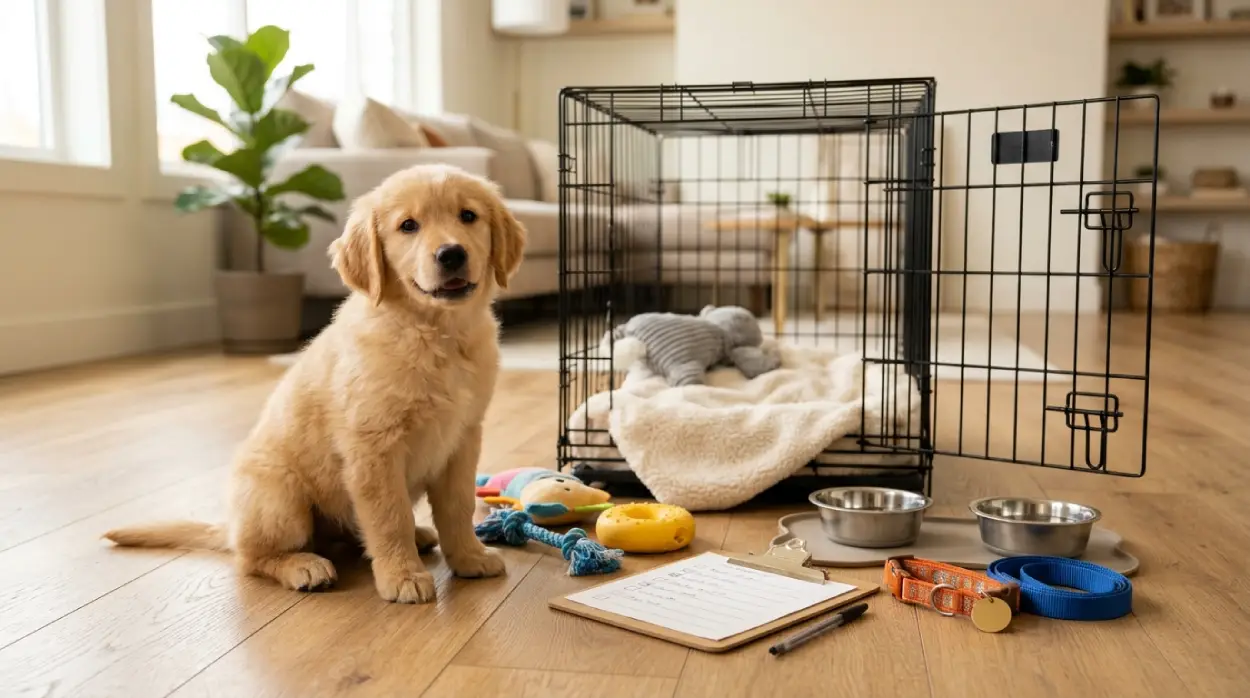
Before your new puppy comes home, you need a few essentials: food and bowls, a crate sized so the puppy can stand up and turn around, a collar with an ID tag, a leash, chew toys, and an enzyme cleaner for accidents. In the first week, book a vet visit, start a simple potty routine, introduce the crate gently, and begin safe socialization. And, of course, choose a name.
This checklist covers what to buy, how to puppy-proof your home, a day-by-day plan for the first week, and what veterinary and behavior experts recommend for vaccines, house training, and socialization. I'm not a vet, so I've linked every health recommendation to its source. Always follow your own veterinarian's advice.
🛒 What to buy before your puppy comes home
🍽️ Food & water
- ☐The same food the breeder or shelter used (switch gradually later)
- ☐Food and water bowls (stainless steel is easy to clean)
- ☐Small training treats
🛏️ Sleep & safety
- ☐A crate big enough to stand up and turn around in, with a divider if the puppy will grow (UC Davis)
- ☐A washable bed or blanket
- ☐Baby gates or a playpen
🦮 Walking & ID
- ☐An adjustable collar or harness
- ☐An ID tag with your phone number
- ☐A standard leash (about 6 ft / 1.8 m)
- ☐Poop bags
🧼 Hygiene & grooming
- ☐An enzyme cleaner for accidents
- ☐A soft brush suited to the coat
- ☐Puppy-safe shampoo
- ☐Nail clippers
🧸 Enrichment
- ☐Several chew toys in different textures
- ☐A puzzle or food-dispensing toy
- ☐A soft toy for comfort
📄 Paperwork
- ☐Vaccination and deworming records (AKC)
- ☐Microchip registration details
- ☐Your vet's phone number and the nearest emergency clinic
Tip from the AKC: ask the breeder or shelter for a few days' supply of the puppy's current food and, if possible, a toy or blanket that smells like the litter. Familiar food and scents make the move less stressful (AKC).
🏠 Puppy-proof your home
Puppies explore with their mouths. Get down to puppy height and look for anything they could chew, swallow, or knock over.
| Hazard | Why it matters | What to do |
|---|---|---|
| Xylitol (sugar-free gum, some peanut butters, toothpaste) | Can cause dangerously low blood sugar and possibly liver damage (ASPCA) | Keep bags, purses, and bathrooms closed. |
| Chocolate | Contains methylxanthines; darker chocolate is more dangerous (ASPCA) | Store on high shelves or in cupboards. |
| Grapes and raisins | Can cause kidney damage in dogs (ASPCA) | Never leave fruit bowls within reach. |
| Onions, garlic, and chives | Can damage red blood cells (ASPCA) | Keep cooking scraps out of the trash the puppy can reach. |
| Electrical cords | Chewing can cause burns or shocks | Hide cords behind furniture or in covers. |
| Medications and cleaning products | Can be toxic in small amounts | Lock them in cabinets. |
| Toxic plants | Some common plants, like lilies and English ivy, are toxic to pets | See our plant safety table. |
Save this number: if you think your puppy ate something toxic, call your vet right away. In the US, the ASPCA Animal Poison Control Center is at (888) 426-4435 (a fee may apply).
📅 Your first-week plan
| When | Focus | What to do |
|---|---|---|
| Day 1 | Calm arrival | Take the puppy straight to the potty spot. Show the water, bed, and crate. Keep visitors to a minimum and let the puppy sleep a lot. |
| Days 1–3 | Routine | Feed, potty, play, and nap at the same times every day. Take the puppy out after meals, naps, and play. |
| Days 2–4 | Vet visit | Bring the vaccine and deworming records. Ask about the vaccine schedule, parasite prevention, microchipping, and when to start puppy class. |
| Days 3–7 | Crate & name | Feed meals near or in the crate. Say the puppy's name before good things happen: food, play, cuddles. |
| Days 5–7 | Gentle socialization | Short, positive experiences: new sounds, surfaces, and calm, healthy people and dogs you trust. |
🩺 First vet visit and vaccines
Book a checkup within the first few days. According to the Animal Medical Center in New York, the core vaccines for dogs are distemper, adenovirus, parvovirus, and rabies. Puppy parvovirus shots usually start at 6 to 8 weeks of age and are repeated every 2 to 4 weeks until the puppy is at least 16 weeks old, or 18 to 20 weeks in high-risk areas (Animal Medical Center). Rabies timing depends on local law, so ask your vet.
Your vet will tailor the plan to your puppy's age, history, and lifestyle, and may also recommend non-core vaccines, deworming, and flea and tick prevention.
🚽 House training basics
Puppies need to go out often. The AKC notes that puppies usually need to go after they eat or drink, when they wake up, and after play. Once a puppy is about 16 weeks old, a common rule of thumb is that they can hold their bladder for their age in months plus one hour. A 4-month-old can wait about five hours (AKC).
- Use the same spot every time, and reward your puppy the moment they finish.
- Watch for signals like sniffing, circling, or hunching.
- Clean accidents with an enzyme cleaner so the smell doesn't invite a repeat.
- Never punish accidents. It only teaches your puppy to hide from you.
🛏️ Crate training
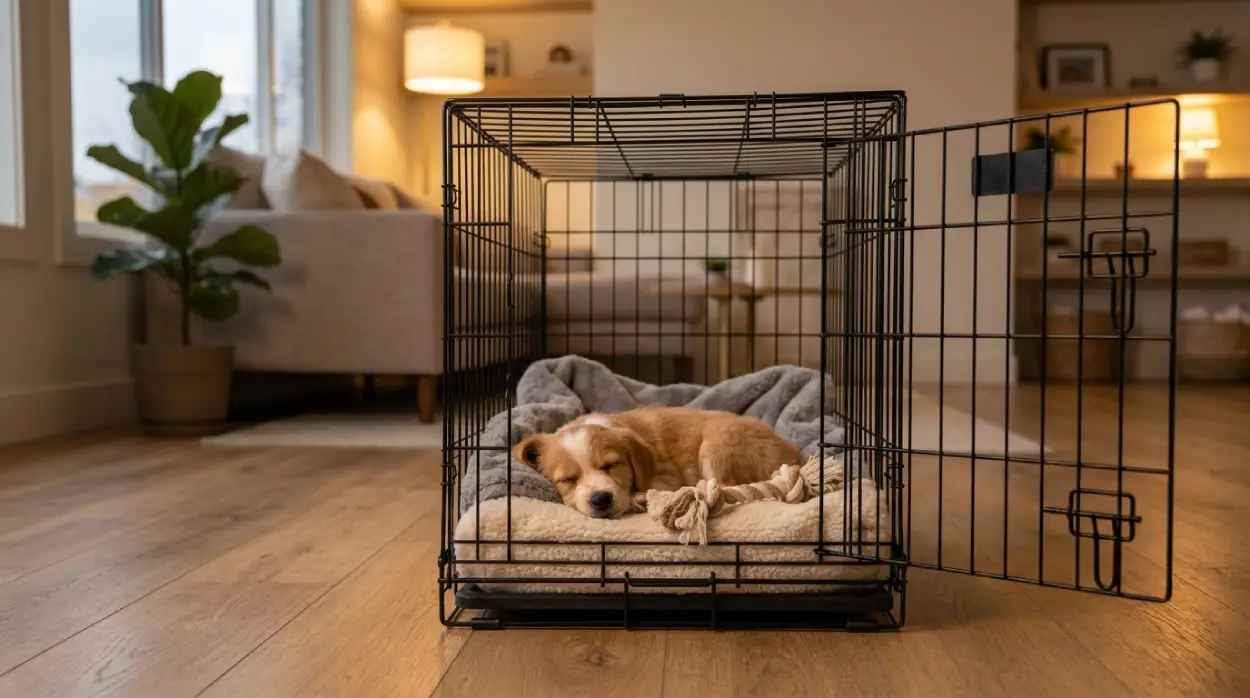
A crate gives your puppy a safe den and helps with house training. UC Davis veterinary behavior experts advise choosing a crate where the puppy can stand up and turn around freely, without so much space that one end becomes a toilet. They also stress that crates should never be used as punishment, and that accidents in the crate usually mean the puppy needs to go out more often (UC Davis).
🐕 Socialization: the most important window
The early months shape how your puppy will feel about the world for life. The American Veterinary Society of Animal Behavior (AVSAB) recommends that puppies can start socialization, such as a puppy class, as early as 7 to 8 weeks of age, once they have had at least one set of vaccines and are staying up to date. The AVSAB notes that more dogs under 3 years old die because of behavior problems than because of infectious diseases (dvm360 / AVSAB).
Keep it safe and positive: choose puppy classes that require vaccines, avoid dog parks and areas where unknown dogs gather until your vet says it's safe, and let your puppy watch new things from a distance before getting closer.
🏷️ Name, tag, and microchip
Choosing a name is one of the best parts of getting a puppy, and it's also a safety step. In a study of 53 US shelters, microchipped dogs were returned to their owners 52.2% of the time, compared with 21.9% of dogs without a chip, and missing or wrong owner information was the most common reason chipped dogs didn't go home (dvm360). Put the name and your phone number on a tag, and register the microchip in your name.
For the name itself, the AKC advises skipping names that sound like commands, and short names are easiest to call. Need ideas? Start with our guide to choosing a dog name or our short and sweet dog names. Then see how long it takes a puppy to learn its name.
✅ Quick checklist
- ☐ Supplies bought: food, bowls, crate, bed, collar, ID tag, leash, toys, enzyme cleaner
- ☐ Home puppy-proofed: toxic foods, cords, medications, plants
- ☐ Vet visit booked for the first few days
- ☐ Potty spot chosen and routine planned
- ☐ Crate set up with a soft blanket
- ☐ Puppy class researched (vaccines required)
- ☐ Name chosen, tag engraved, microchip registered
🎲 Still choosing a name?
Our free Pet Name Generator gives you a shortlist in seconds. Choose Dog, pick a gender, and add a trait that fits your puppy, like Playful, Cute, or Brave. Adopting an adult dog instead? Read our rescue pet naming guide, and when your puppy is settled, our dog training tips will help with the next steps.
❓ Frequently asked questions
What do I need to buy for a new puppy?
The essentials are food and bowls, a crate the puppy can stand up and turn around in, a bed, a collar or harness with an ID tag, a leash, poop bags, chew toys, an enzyme cleaner for accidents, and basic grooming tools.
When should a puppy have its first vet visit?
Within the first few days after coming home. Puppy vaccines usually start at 6 to 8 weeks and are repeated every 2 to 4 weeks until at least 16 weeks of age, according to the Animal Medical Center.
How long can a puppy hold its bladder?
After about 16 weeks, a common rule of thumb from the AKC is the puppy's age in months plus one hour. A 4-month-old can wait about five hours. Younger puppies need to go out much more often.
When can a puppy start socialization?
The AVSAB says puppies can start socialization, such as puppy classes, as early as 7 to 8 weeks of age, once they have had at least one set of vaccines and stay up to date.
What foods are dangerous for puppies?
The ASPCA warns against xylitol, chocolate, grapes and raisins, and onions, garlic, and chives, among other foods. Call your vet right away if your puppy eats any of them.
Sources
- Animal Medical Center: What vaccines does my dog really need?
- dvm360: AVSAB position on puppy socialization
- ASPCA: People foods to avoid feeding your pets
- UC Davis Veterinary Medicine: Crate training your puppy
- American Kennel Club: Why does my puppy keep peeing in the house?
- American Kennel Club: Items to include in a puppy kit
- dvm360: Lost dogs and the way home (Lord et al., JAVMA, 2009)
- American Kennel Club: Puppy names
This guide is for general information and doesn't replace advice from your veterinarian.

Riley Fox is the pen name of the independent web developer who built and runs Pet Name Generator from Campo Grande, Brazil, a tree-lined city at the edge of the Pantanal. Riley shares home with three cats, Mindinha (a tuxedo), Kuku (a Siamese) and Lelinho (an orange tabby), plus Mille, a very sociable Shih Tzu. Riley writes every naming guide and pet-care tip on the site, researching each one with veterinary and animal-welfare sources. Not a vet, just a dedicated pet parent. More on the About page.