
🏷️ Guides · 📅 Updated November 12, 2026 · ✍️ By Riley Fox · ⏱ 9 min read
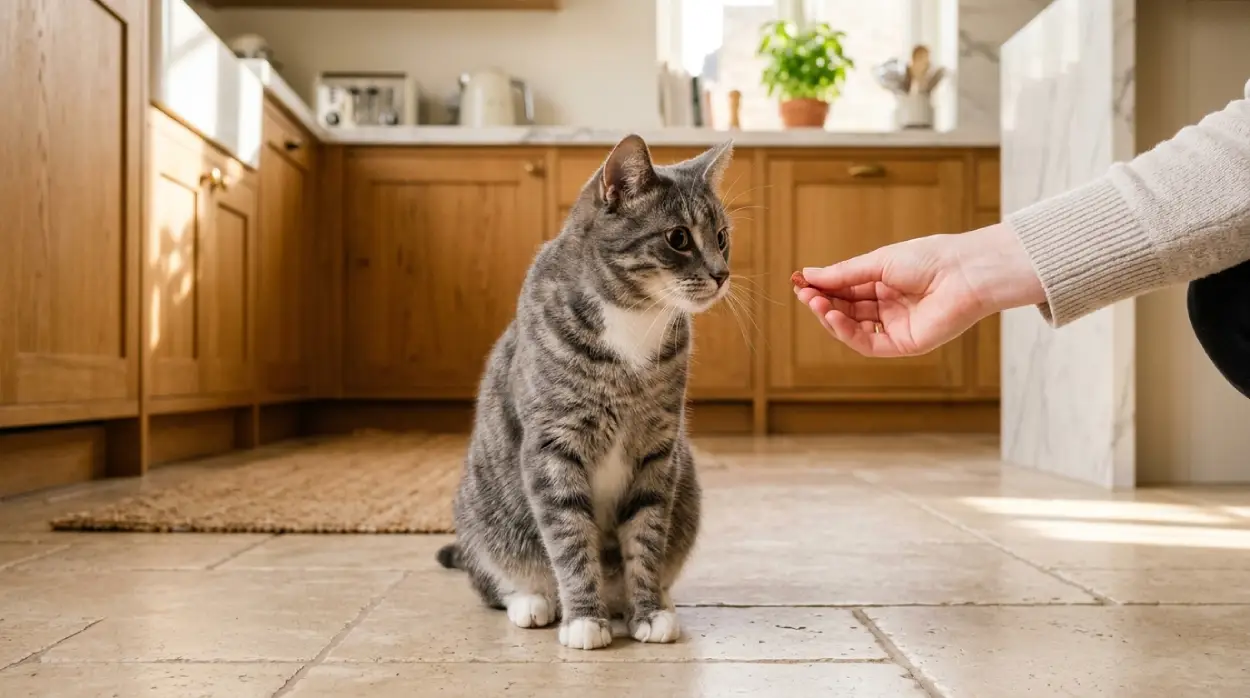
Cats can learn their names. The trick is making the name the best word they hear all day.
To teach a cat its name, say the name once in a soft, happy voice, and the moment your cat looks at you or turns an ear, give a reward they love, like a tiny treat, play, or petting. Repeat this in short sessions every day, then practice from farther away and in other rooms. Rewards work best when they come immediately after the behavior (American Association of Feline Practitioners), and sessions can be very short: even 30 seconds counts (Humane Colorado).
Below you'll find what the science says, a five-step training plan, a list of mistakes to avoid, and what to do if your cat ignores you. For a broader timeline across species, see how long it takes a pet to learn its name.
🔬 Can cats really learn their names?
Yes. In a 2019 study published in Scientific Reports, researchers in Japan played recordings of four words that sounded like each cat's name, followed by the cat's real name. Many cats stopped reacting to the similar words but moved their ears or heads when they heard their own name. The team tested 77 cats across four experiments (ScienceDaily; National Geographic).
Two details are useful for owners. First, cats living in homes were better at telling their own name apart from the names of the other cats they lived with than cats living in a cat café, where many cats share a space. Second, a cat that doesn't respond may still recognize its name; it may simply not feel like interacting at that moment (ScienceDaily).
A follow-up study from Kyoto University in 2022 went further: household cats appeared to link the names of their companion cats and family members with their faces, without being trained to. The effect was stronger in cats that had lived with their families longer (Sci.News).
What this means for you: your cat is already listening. Training doesn't teach your cat to hear the name. It gives your cat a reason to respond to it.
🎁 Before you start: pick the name and the reward
Choose a name that's easy to tell apart from other words your cat hears every day:
- Keep it short. One or two syllables are easy to say the same way every time.
- Make it distinct. Avoid names that sound like your other pets' names or like words you say often.
- Pick one version. Use the same name while training, and save nicknames for later.
Next, find out what your cat finds rewarding. Not every cat works for food. The AAFP cites a study in which 50% of cats preferred human social interaction, 37% preferred food, 11% preferred toys, and 2% preferred a scent (AAFP). Offer a few options and watch which one your cat engages with most. For food rewards, small, soft, smelly treats work well (Humane Colorado).
📋 How to teach a cat its name in 5 steps
1. Start in a quiet room
Pairing
When your cat is calm and nearby, say the name once and immediately give the reward. Do this a few times. You’re building the link: name = good things.
2. Wait for a response
Reward attention
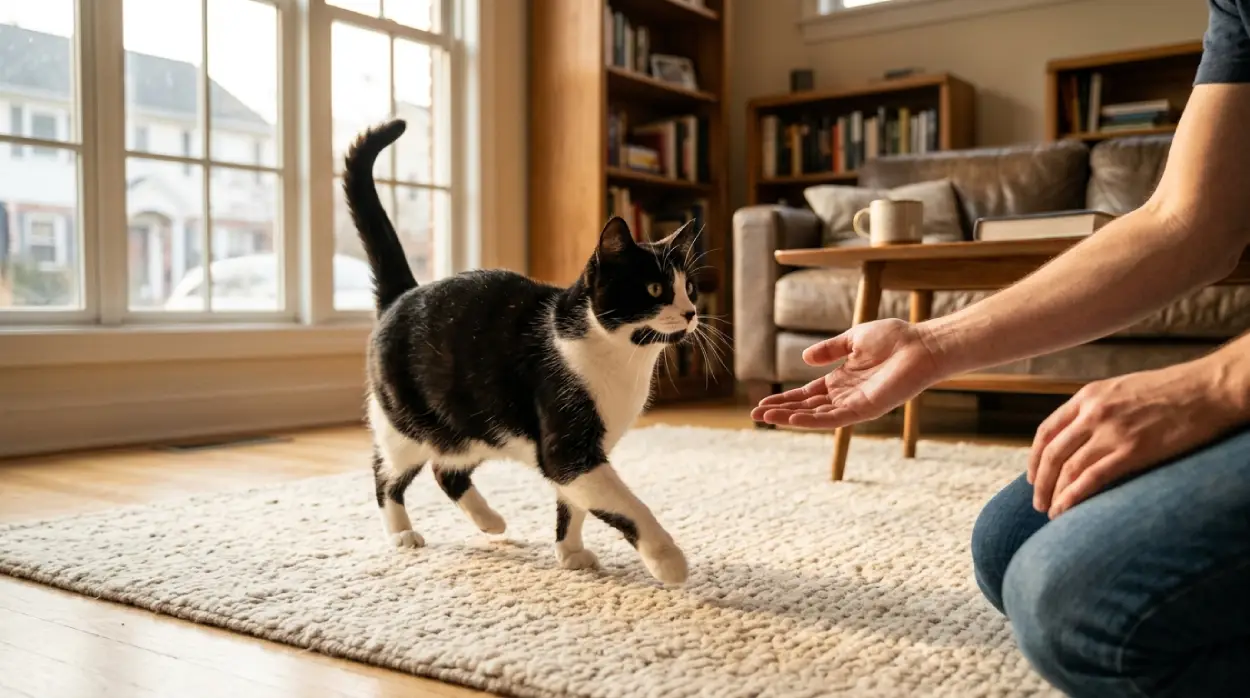
Say the name when your cat isn’t looking at you. The second your cat turns their head or an ear, reward. Don’t repeat the name; wait.
3. Add distance
A few steps away
Call from across the room, then from the doorway. Reward any look, ear turn, or step toward you.
4. Try other rooms
Real life
Practice in different rooms and at different times of day, with a little more going on around you.
5. Use it every day
Make it routine
Say the name before meals, play, and petting. Every good moment that follows the name makes it stronger.
Keep sessions short and stop while your cat is still interested. If your cat loses interest, take a play break and try again later (Humane Colorado). Train each cat on their own, in a calm space without distractions (AAFP).
✅ Do this, not that
| Do | Avoid |
|---|---|
| Say the name once, in a soft, happy voice | Repeating the name over and over |
| Reward within a second of the response | Rewarding late, after the moment has passed |
| Use the name before meals, play, and petting | Using the name to scold or before the carrier, nail trims, or baths |
| Keep sessions short and fun | Long sessions or training a cat that’s scared, sick, or in pain |
| Train each cat separately | Calling several cats at once with the same treat |
The AAFP also advises not training cats that are fearful, ill, or in pain (AAFP). If your cat suddenly stops responding to sounds or seems unwell, check with your vet.
🖱️ Should you use a clicker?
A clicker is optional. It marks the exact moment your cat did the right thing, which helps with timing. Start by clicking and then giving a treat about five times, with nothing required from your cat (Humane Colorado). Some cats find the click startling; you can muffle it in a pocket or a cloth, or use a short word like "Yes!" instead (AAFP; Humane Colorado).
🤔 Troubleshooting
- My cat ignores the name. That doesn't mean your cat hasn't learned it. In the 2019 study, some cats that didn't respond may simply not have felt like interacting. Raise the value of the reward and practice when your cat is relaxed and a little hungry.
- I have several cats. Cats in homes can tell their name apart from their housemates' names (ScienceDaily). Train each cat separately, and choose names that don't sound alike.
- My cat is deaf or very sensitive to sound. Use a hand signal or a flashlight as the marker instead (AAFP; Humane Colorado).
- I adopted an adult cat with a name. You can keep it or choose a new one. Our rescue pet naming guide covers both options, and the same five steps work for a new name.
⭐ Quick tips
- ✓ Short, distinct names are easier to learn
- ✓ Find the reward your cat really wants: food, play, or petting
- ✓ Say the name once, then wait
- ✓ Reward within a second
- ✓ Practice in short sessions, every day
- ✓ Never use the name for bad news
🎲 Still choosing a name?
If your cat is new, pick a name that's easy to teach. Our free Pet Name Generator gives you a shortlist in seconds: choose Cat, pick a gender, and add a trait like Smart, Sweet, or Independent. You can also read our guide to choosing a cat name, browse orange cat names, black cat names, or Japanese cat names, and if your cat just arrived, see our guide to bringing home a new cat.
❓ Frequently asked questions
Can cats recognize their own names?
Yes. A 2019 study in Scientific Reports found that many cats reacted to their own name after hearing similar-sounding words, and household cats could tell their name apart from the names of cats they lived with.
How do you teach a cat its name?
Say the name once in a happy voice and reward your cat with a treat, play, or petting the moment they look at you or turn an ear. Practice in short sessions, then add distance and other rooms.
How long does it take a cat to learn its name?
There is no fixed timeline; it varies from cat to cat. Short daily sessions and using the name before good things, like meals and play, help your cat learn it faster.
Why does my cat ignore its name?
Your cat may know the name but not feel like responding. Use a reward your cat values more, practice when your cat is relaxed, and avoid using the name to scold.
Can you teach an adult or rescue cat a new name?
Yes. Adult cats can learn a new name with the same steps: pair the new name with rewards, keep sessions short, and use it consistently.
Sources
- ScienceDaily: Cats recognize their own names (Saito et al., 2019)
- National Geographic: Cats recognize their names
- Sci.News: Cats learn names of their feline friends (Takagi et al., 2022)
- American Association of Feline Practitioners: Positive reinforcement techniques
- Humane Colorado: Cat clicker training

Riley Fox is the pen name of the independent web developer who built and runs Pet Name Generator from Campo Grande, Brazil, a tree-lined city at the edge of the Pantanal. Riley shares home with three cats, Mindinha (a tuxedo), Kuku (a Siamese) and Lelinho (an orange tabby), plus Mille, a very sociable Shih Tzu. Riley writes every naming guide and pet-care tip on the site, researching each one with veterinary and animal-welfare sources. Not a vet, just a dedicated pet parent. More on the About page.