

🏷️ Science · 📅 November 3, 2026 · ⏱ 10 min read

She never asked to be a hero. She was just a hungry, gentle stray who happened to trust the humans who found her — and that trust sent her further than any living creature had ever gone before.
On a freezing November night in 1957, a small dog with no pedigree, no name, and no idea what awaited her was sealed inside a padded metal capsule at a launch site in the Kazakh desert. A few hours later, she became the first living creature in history to orbit the Earth. Her name was Laika, and sixty-nine years later, she is still one of the most quietly heartbreaking figures in the entire history of space exploration.
This isn't a list article. It's her story — the whole of it, including the parts the world wasn't told for nearly half a century. Nearly seventy years later, people still search her name, still write about her, still name their own pets after her. That kind of staying power doesn't happen by accident. It happens because there's something in her story — the fear, the trust, the sacrifice — that still means something to anyone who has ever loved an animal. At the end of this article, we've gathered a collection of pet names inspired by Laika's courage and the space program that carried her, for anyone who wants their own companion to carry a little piece of that legacy.
🐾 Who Was Laika, Really?
Before she was Laika, she was just one of thousands of stray dogs wandering the streets of Moscow, scraping by on scraps and shelter wherever she could find it. Soviet scientists deliberately chose strays like her for the early space program, reasoning that any dog who had already survived hunger, cold, and hardship on the street would be tough enough to withstand the extremes of spaceflight.
She weighed only about 6 kilograms (13 pounds) and was likely part Samoyed and part terrier, with a calm, even temperament that made her stand out immediately among the other candidates. Researchers originally called her Kudryavka, meaning "Little Curly," but she earned the name history remembers her by — Laika, Russian for "Barker" — after she barked during a radio broadcast introducing her to the Soviet public.
Handlers described her as sweet-natured and easy to please. One of the scientists who trained her, Vladimir Yazdovsky, was so fond of her that he brought her home to play with his own children just days before the launch, later saying he wanted to give her something good before her time ran out.
Training wasn't gentle. Laika and the other candidate dogs spent weeks confined in progressively smaller boxes to get them used to the tiny Sputnik 2 capsule, and they were strapped into centrifuges to simulate the crushing g-forces of launch. Loud engine noises were played on repeat so the dogs wouldn't panic during liftoff. Through all of it, Laika reportedly stayed calmer than most of the other candidates, which is part of why she was ultimately chosen for the flight that would make her famous.
🚀 The Sputnik 2 Mission: A One-Way Ticket to History
Laika's flight almost didn't happen on its own terms. Just a month earlier, the Soviet Union had stunned the world with Sputnik 1, the first artificial satellite ever launched. Premier Nikita Khrushchev wanted an even bigger follow-up in time for the 40th anniversary of the Bolshevik Revolution — and he wanted it fast. Engineers were given roughly four weeks to build an entirely new spacecraft capable of carrying a living passenger. There was no time to design a way to bring her back.
Three days before launch, Laika was placed into her small pressurized capsule, fitted with a harness that let her stand, sit, or lie down, but never turn around. Sensors had been surgically implanted to monitor her heartbeat and breathing. When Sputnik 2 lifted off from the Baikonur Cosmodrome on November 3, 1957, the g-forces climbed to five times normal gravity, and telemetry showed her heart racing to roughly three times its resting rate.
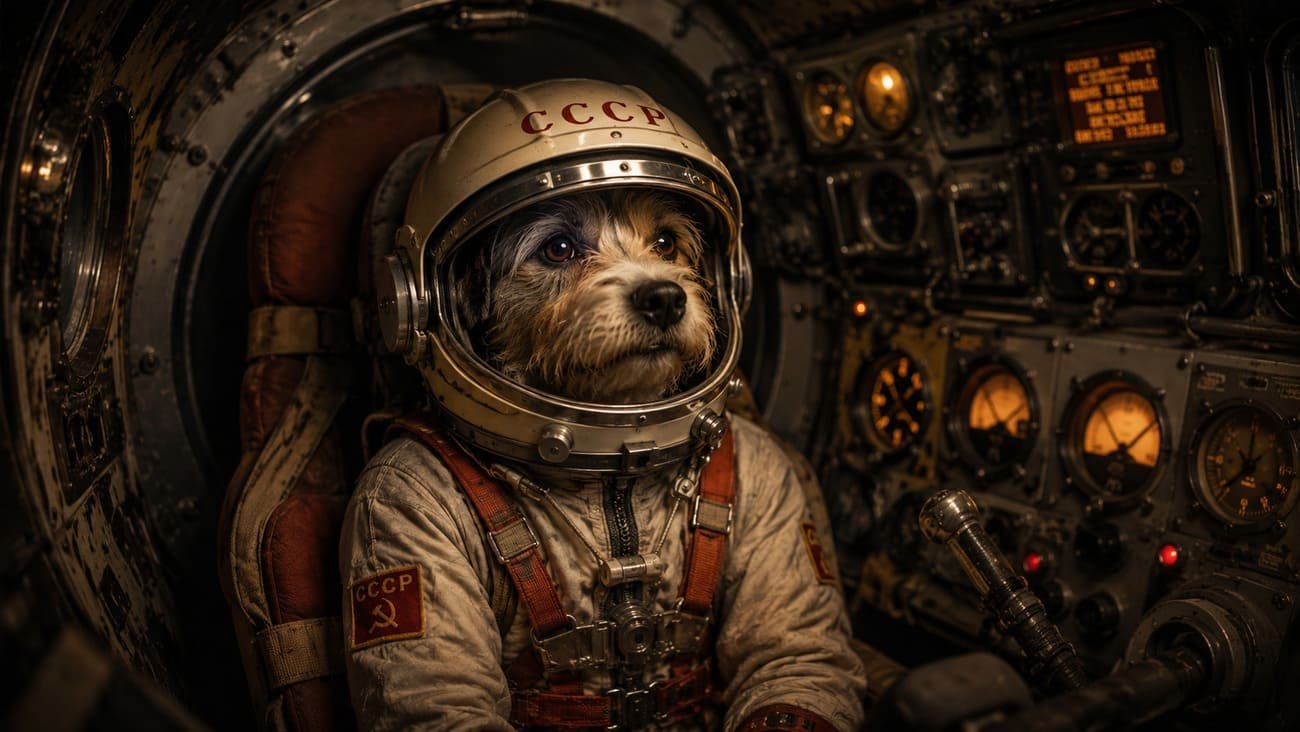
She made it to orbit. For the first time ever, a living creature was circling the planet — and for a moment, that felt like triumph enough for the scientists watching the data stream in.
Inside Soviet mission control, there was genuine excitement mixed with quiet unease. The engineers knew, even as they celebrated, that Sputnik 2 had no heat shield, no parachute system, and no plan for bringing its passenger home. The mission had been approved on a political deadline, not a fully solved engineering problem — and everyone involved understood, before Laika ever left the ground, exactly what that meant for her.
💔 The Truth About Laika's Final Hours
For 45 years, the world was told a gentler version of what happened next: that Laika lived comfortably in orbit for several days before painlessly running out of oxygen. It was a story crafted for public consumption, and it worked — newspapers around the world mourned her as a peaceful space heroine.
The real story was far crueler, and it stayed classified for decades. In October 2002, Russian scientist Dimitri Malashenkov finally presented the mission's actual telemetry data at the World Space Congress in Houston. The data showed that Laika died of overheating and stress during the spacecraft's fourth orbit, roughly five to seven hours after launch, after insulation problems let the cabin temperature climb far past safe limits. She never made it to day two, let alone day six.
Oleg Gazenko, one of the scientists who had helped select her for the mission, carried visible regret about it for the rest of his life. Decades later, he reflected that the more time passed, the sorrier he felt about what had been done to her. It's a rare thing, hearing a scientist admit that the data wasn't worth the cost — and it's part of why Laika's story still resonates the way it does.
Her capsule, carrying her remains, continued to silently circle the Earth for another five months before finally burning up on re-entry over the North Atlantic in April 1958 — a quiet, unwitnessed final orbit for a dog the whole world had once been watching.
🐕 Not Alone: The Other Dogs of the Soviet Space Program
Laika is the name history remembers, but she was part of a much larger program that trained dozens of stray dogs for suborbital and orbital test flights throughout the 1950s and 60s. Here are a few of the others who shared her extraordinary, dangerous journey:
Dezik & Tsygan
In 1951, these two became the first dogs ever to survive a suborbital spaceflight, reaching the edge of space and returning safely by parachute — proof that a living creature could endure the trip at all.
Albina
Laika's backup for the Sputnik 2 mission, Albina had already flown a successful suborbital test earlier that year. She was spared the fatal flight — Laika was chosen instead just over a week before launch.
Belka & Strelka
Three years after Laika's death, the Soviet Union finally had the technology to bring dogs home safely. In 1960, Belka and Strelka became the first Earth-born creatures to orbit the planet and return alive, paving the way for Yuri Gagarin's historic human flight in 1961.
🧠 Laika's Legacy: From Propaganda Symbol to Space Hero
Laika's flight sparked one of the earliest global conversations about animal ethics in scientific research — protesters marched outside the United Nations days after her launch, and the debate she started still shapes how space agencies think about using animals today. In 2008, more than fifty years after her flight, Russia unveiled a small monument near the Moscow facility where she trained: a bronze dog standing proudly atop a rocket, forever looking upward. She's remembered now not as a piece of Cold War propaganda, but as the small, brave dog who made human spaceflight possible.
✨ Pet Names Inspired by Laika and the Space Race
If Laika's courage moved you the way it moves us, here's a curated collection of space-program names for a pet who deserves a name with real history behind it — whether you want to honor Laika directly or celebrate the wider story of animals and humans reaching for the stars together.
Laika
The name itself — "Barker" in Russian, and forever tied to bravery and firsts.
Kudryavka
Laika's original name, meaning "Little Curly" — sweet and unexpected.
Sputnik
The satellite program that started it all, meaning "fellow traveler."
Belka
One of the first dogs to safely orbit Earth and return — means "squirrel."
Strelka
Belka's mission partner, whose puppy Pushinka was later gifted to the Kennedy family.
Gagarin
After Yuri Gagarin, the first human in space, whose flight Laika's mission made possible.
Yuri
A softer, first-name option carrying the same pioneering spirit.
Orbit
Simple, modern, and a direct nod to Laika's historic achievement.
Vostok
The Soviet spacecraft program that followed Sputnik, meaning "east."
Cosmo
A playful, approachable nod to "cosmonaut" for a pet with big energy.
Nova
A bright, star-born name for a pet who lights up every room.
Comet
For the fast, fearless pet who's always the first one out the door.
Zvezda
Russian for "star" — an elegant tribute to Laika's homeland.
Rocket
Bold and a little bit funny — perfect for a small dog with a big personality.
Moscow
A quiet nod to the city streets where Laika's story actually began.
Dezik
Honoring the very first dog to survive a spaceflight and come home.
Tsygan
Dezik's flight partner — a name meaning "gypsy," with real pioneering roots.
Baikonur
Named for the launch site itself — unusual, striking, and full of history.
🌌 Why Laika's Story Still Matters
It would be easy to file Laika away as a piece of Cold War trivia — a strange, sad footnote from the early days of the space race. But her story keeps resurfacing, in documentaries, in graphic novels, in bands and songs named after her, because it touches something that has nothing to do with rockets at all: the quiet, complicated love between humans and the animals who trust us completely, even when we don't always deserve it.
Every dog who has ever waited by a door, ridden along on a car trip without asking where it's headed, or simply followed a beloved human into an unfamiliar room has a little bit of Laika in them. She didn't understand what a satellite was, or what orbit meant, or that she'd never come home. She just went, because the people around her asked her to. That's not a small thing. It might be the whole reason her story has outlived the empire that sent her up there.
❓ Frequently Asked Questions About Laika
Was Laika the first animal in space?
No. Fruit flies and several dogs, including Dezik and Tsygan, had already flown on shorter suborbital trips before her. Laika's mission was different because she was the first living creature to actually orbit the Earth.
Did Laika suffer during the flight?
Yes. Telemetry data released in 2002 confirmed she died from overheating and stress within about five to seven hours of launch, far sooner and far more painfully than the Soviet Union originally claimed.
Is Laika still in space?
No. Her capsule aboard Sputnik 2 orbited Earth for about five months after her death before burning up on re-entry over the North Atlantic in April 1958.
What breed was Laika?
She was a mixed-breed stray, likely with some Samoyed and terrier ancestry, weighing around 6 kilograms (13 pounds). She had no formal pedigree — just street smarts and a calm temperament.
Why is Laika's name a popular pet name today?
Laika has become a name associated with courage, curiosity, and adventure, making it a meaningful choice for owners who see a bit of that same brave spirit in their own pet.
Are Belka and Strelka related to Laika's mission?
They weren't part of Laika's flight, but their success three years later was built directly on lessons learned from her mission. Belka and Strelka became the first dogs to orbit the Earth and return home alive, proving the safe re-entry technology Laika's flight never had.
Give Your Pet a Name With Real Courage Behind It
Try our free generator with the "Famous" theme and the "Brave" or "Adventurous" trait selected for more space-hero-worthy name ideas.
Open Pet Name Generator